How snow and ice buildup damages your outdoor HVAC components
Winter weather can damage furnaces and AC’s in quite a few ways. Unlike rain, snow and ice don’t evaporate right away. Instead, they build up and cause a host of problems.
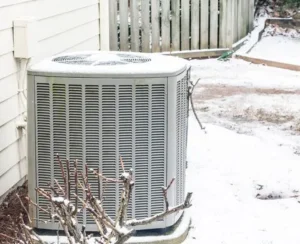
AC condensers are especially vulnerable. Most of the important parts on them are exposed. Take a look at your condenser. You can see the aluminum fan right through the top. And, there are all those slotted fins on the outside.
Those coil fins are especially easy to damage. When moisture gets in between them, you run into trouble when it freezes over. The ice expands and can bend those coils.
When that happens, air can’t flow through the system as well. You’ll start off hearing some weird loud noises from the unit. Eventually, it’ll just get more damaged.
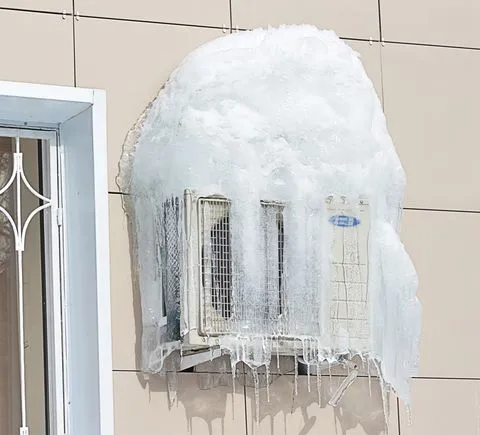
Elsewhere, icicles can be a big problem. That depends a lot on how close the unit is to the house or gutters. You’d be surprised how much damage falling ice can do.
We’ve seen the coils and the guard on top of condensers all bent out of shape from impact like this. Sometimes, the ice even manages to ding the fan pretty badly. Then, you get the problem of the ice getting inside the unit.
Eventually, it melts and seeps further inside the unit. When it re-freezes, it can wreak having on those inner components.
In fact, rust and corrosion is a big problem from winter weather. All that precipitation means the unit is exposed to a lot of moisture for a long time. That takes its toll.
Winter weather affects HVAC air flow
We’ve looked at how the elements can ding up your outdoor HVAC components. But, there’s another problem that’s harder to spot: air flow.
When ice and snow build up around, on, or in your HVAC system, they make it harder for air to flow through them. Once this happens, air can’t circulate as well as needs to. That’s when you end up paying more money every month.
How does this happen? Basically, you’re looking at ice buildup at the intake vents and exhaust. We’ve seen some cases where a massive block of ice formed in the piping that leads from the condenser to the system inside.
Maybe a little more commonly, we’ll see it on the exhaust ports. That’s where air from inside the house gets circulated back outside.
In both these cases, what you get is restricted airflow through your HVAC system. That means it needs to create more pressure to push the air through the house. To create more pressure, it uses more energy.
And, that’s more energy you end up paying for. Whether your system uses gas, oil or resistive electricity to warm your house, it’s going to need more to get the job done.
Meanwhile, there’s an added problem when it comes to exhaust: carbon monoxide. This poisonous gas is created when the system burns fuel.
When everything’s working properly, it gets sent right outside through the exhaust. But, if that channel is clogged, then it can build up in the system and eventually the house.
Now, when it comes to the heating unit, things work a little differently. Remember, it attracts thermal energy that’s outside and sends it into your home. The pump draws heat from all four sides. Any area that’s covered can’t do that as well as parts that are clear.
So, now that we’ve gone through all the ways your outdoor HVAC equipment can get damaged by winter weather, let’s look at some ways to prevent it from happening.

 Here are some easy steps you can take to protect your heat pump and air conditioner from snow and ice damage: